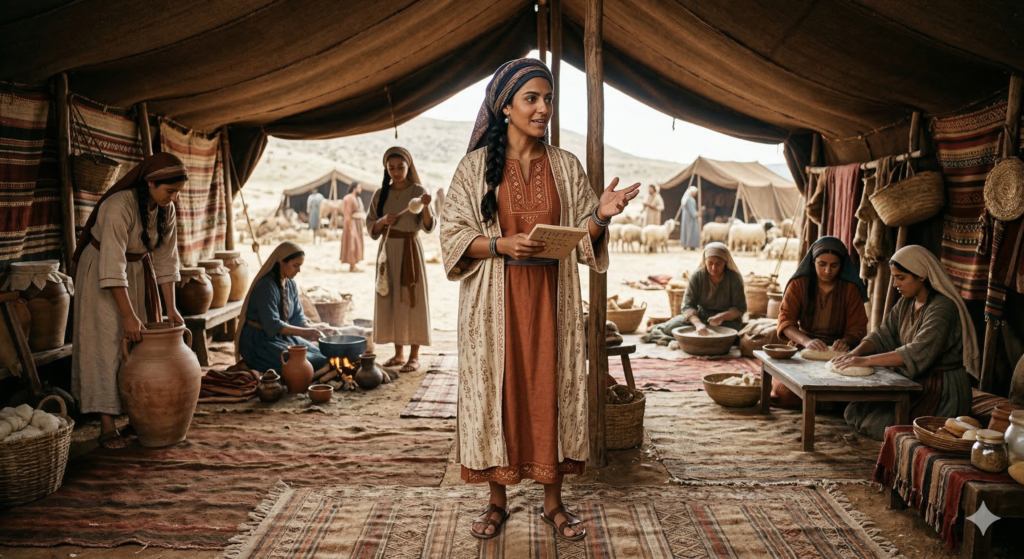
Sarah’s Blueprint for the Modern Woman
Imagine the heat of the Canaanite sun reflecting off the canvas of a massive nomadic camp. At the center of this bustling enterprise stood Sarah. While history often remembers her as the wife of a patriarch, she was the “princess” of a desert empire—a woman who moved with a quiet, formidable authority.
Sarah’s life offers a striking pattern for the modern woman who feels caught between the desire to lead and the call to love. She wasn’t a “diva” demanding center stage; she was the foundation that allowed the stage to stand. When Abraham entertained heavenly visitors, it was Sarah who managed the logistics of the feast, turning a tent into a sanctuary of hospitality. She didn’t just follow Abraham into the wilderness; she co-managed the journey, overseeing a household of hundreds with a steady hand.
She modeled a “soft power” that many modern women strive for. She supported Abraham’s divine calling without becoming a shadow. When she spoke, her words carried such weight that even the heavens instructed Abraham to listen to her. She proved that being feminine doesn’t mean being fragile, and being capable doesn’t require being cold. Her strength was her dignity—a “command of space” that came from knowing exactly who she was before God.
To emulate Sarah today is to lead your “household”—whether that’s a boardroom, a classroom, or a home—with competence that inspires respect, while maintaining a heart that nurtures partnership. She shows us that a woman can be both the anchor of her husband’s soul and the captain of her own ship.
Reflection & Application
- Auditing Your Authority: In what areas of your life are you currently “shrinking” to avoid appearing too strong, and how can you step into that space with Sarah-like grace instead?
- The Art of Support: How can you champion your partner’s dreams this week in a way that utilizes your unique strengths rather than just staying on the sidelines?
- Defining the Diva: Sarah was formidable but not demanding. Where is the line for you between standing your ground and losing the “quiet strength” that fosters peace in your relationships?